

In the printing and packaging industry, the die-cutting line is a crucial process mark that ensures the accuracy of product shaping. It is marked as a dotted line on the printed materials and guides the precise cutting of materials during subsequent processing. As a bridge connecting design and production, the quality of the die-cutting line directly affects the appearance, functionality, and production efficiency of packaging products.
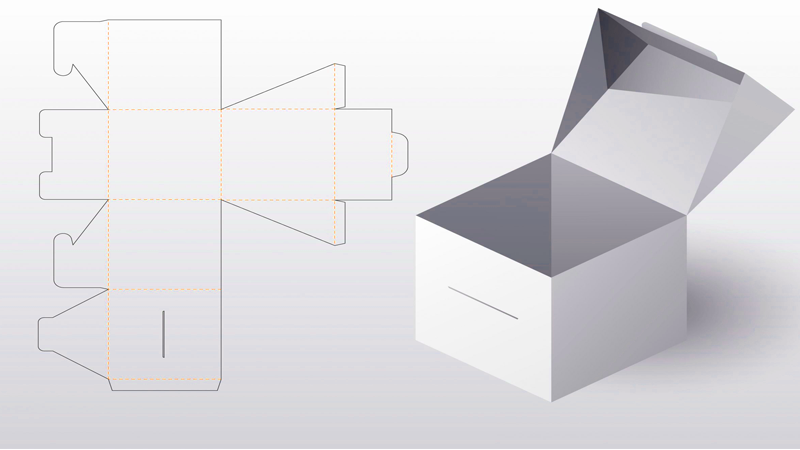
The core definition and function of die-cut lines
Die-cut lines are guiding lines for the post-processing of printed materials. They mark the positions where materials need to be cut or die-cut using dotted lines. Their core functions include: first, positioning the cutting boundaries to ensure that the shapes of packaging boxes, labels, etc. conform to the design specifications; second, optimizing the production process, enabling die-cutting equipment to automatically recognize the processing path and reducing manual intervention; third, ensuring material utilization by precisely planning the lines to avoid waste caused by excessive cutting. In products such as folding cartons, irregular-shaped labels, and hardcover book covers, the accuracy of die-cutting lines directly determines the splicing precision and structural stability of the final products.
The Importance of Die Cutting Lines
Die cutting lines play an irreplaceable role in the production of printing and packaging. Firstly, they serve as the technical foundation for realizing design concepts. Complex irregular structures and precise folding effects all depend on the precise positioning of die cutting lines. Secondly, standardized die cutting lines can significantly enhance production efficiency. Data from a packaging enterprise shows that after adopting standardized die cutting line designs, the production efficiency of the die cutting process increased by 30%, and the defect rate decreased by 15%. Finally, the reasonable design of die cutting lines can reduce material waste. By optimizing the cutting path, it can average a 8% reduction in raw material waste, which is of great significance for cost control of the enterprise.
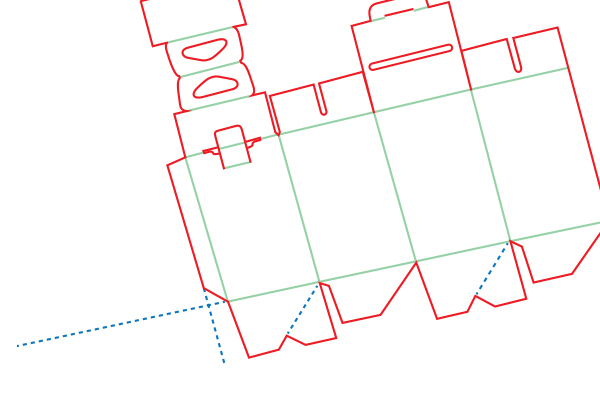
The creation process and technical specifications of die-cut lines
The creation of professional die-cut lines requires strict adherence to process standards. The typical process includes:
1. Design planning: Determine the cutting path based on the product size and material properties, and reserve a 3mm standard bleed area.
2. Software drawing: Use professional design software to create vector lines and set the dashed line style (usually a 0.3pt line width, 2mm line segment + 1mm spacing).
3. Parameter verification: Check the compatibility of the die-cutting template size with the printing file, and ensure that the die lines do not overlap with the graphics.
4. Output format: Export as PDF or AI format, create a separate die-cutting layer and lock it.
The industry standard requires that the die-cut lines should meet the following conditions: the lines should be continuous without any breaks, the corners should have a smooth arc transition (R ≥ 0.5mm), and there should be a minimum spacing of 2mm from the indentation lines to avoid stress concentration during processing which could cause the material to rupture.
Mainstream Design Software and Application Techniques
The commonly used die-cutting line design software in the packaging industry and their features are as follows:
- CorelDRAW: Draws die lines using Bezier tools and supports the "bleed area" function (Path: View → Page Setup → Bleed). Suitable for small and medium-sized packaging designs.
- Adobe Illustrator: Uses the "Path Trimming" tool (shortcut key Ctrl+Alt+X) to create precise die lines, combined with the "Layer Management" function to separate die patterns from graphics.
- ArtiosCAD: A professional packaging structure design software with a built-in die-cutting parameter library. It can automatically generate die lines that meet production standards and is widely used for complex folding structures.
In terms of practical skills, designers should be aware that in CDR, hiding die-cut lines can be achieved through the "Object Manager" function; In AI, the die-cutting line needs to be set to a spot color and "Overprint" should be checked. Before outputting, be sure to perform a "PDF pre-check "to verify if the lines are closed and if there are any extra nodes.
Common Questions and Solutions
Common problems and Countermeasures in die-cut line production:
- Line offset: This occurs due to the mismatch between the coordinate systems of the design software and the die-cutting equipment. The solution is to uniformly use millimeters as the unit and check the "document bleed" option when exporting.
- Excessive nodes: Complex graphics cause the number of knife line nodes to exceed the processing limit of the device. This can be optimized through the "Simplified Path" function (CDR: Object → Path → Simplified) to retain key nodes
- Hidden knife lines: The die-cut lines are lost in the output file. It is necessary to check the layer visibility to ensure that the die-cut layer is not hidden or locked.
- Material adaptation: Different materials require adjustments to the knife-line parameters. For example, corrugated paper needs to have the lines thickened to 0.5pt, while for film materials, the cutting pressure compensation value needs to be reduced.
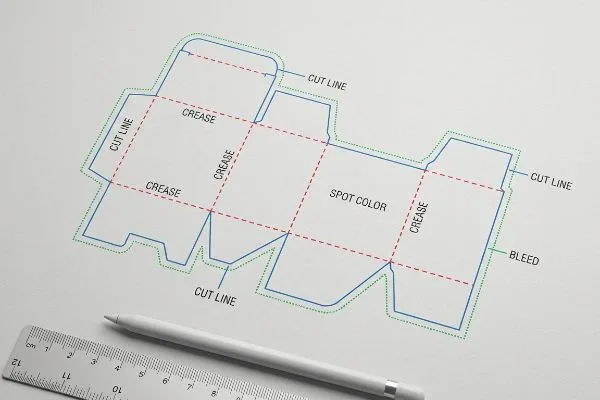
Industry data shows that adopting a digital die-cutting management system can reduce the occurrence rate of the aforementioned problems by 60%. This system achieves full-process quality control from design to processing by automatically verifying die line parameters and monitoring production data in real time. With the intelligent upgrade of the packaging industry, die-cutting line technology is evolving from simple process marking to a digital node of "design - production - quality" collaboration, becoming a key link for enterprises to enhance their core competitiveness.
